
ARTICLES
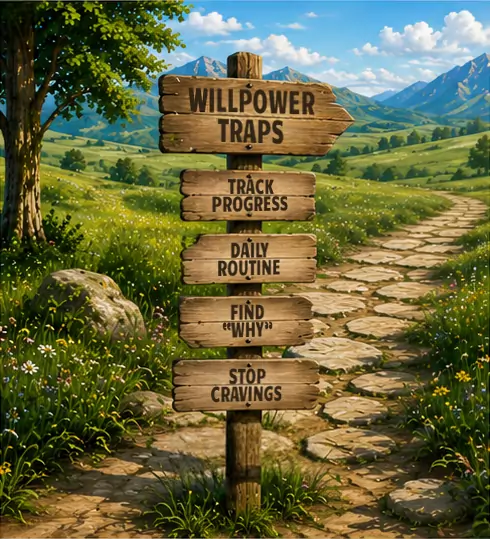
- Willpower Traps
- Track Progress
- Daily Routine
- Find "Why"
- Stop Cravings
Willpower Traps: Failing Has Nothing to Do with How Strong You Are
Why Your Brain Was Never the Problem
You have tried. You have tried hard, more than once, probably more than you can count. And every time the plan fell apart, something inside you said it was your fault. It was not. The real enemy is not weakness. It's a set of invisible traps built from your biology, your environment, and the deliberate engineering of the food system around you.
In This Article:
- Why willpower runs out by evening and what science says to do instead
- The brain chemistry behind why processed food is so hard to stop eating
- How stress, poor sleep, and guilt quietly fuel the same cycle over and over
- The simple system shifts that work better than white-knuckling it ever will
The version of you that kept trying, through every failed Monday and every late-night slip, was never weak. That person was fighting a battle nobody fully explained, with tools that were never going to be enough. That changes now. Everything that follows in this article is what you were never told. Keep reading. You have earned the truth.
You know the feeling.
You wake up and swear today is different. This is the day you get serious. The day you stop grabbing whatever is nearby and start making choices that will actually change your life. You have that morning energy, that clear-headed resolve, and for a few hours it works. You drink water instead of soda. You skip the drive-through. You feel genuinely proud of yourself.
Then life piles on. The kids are loud and relentless. Your back aches. A work problem drags on until you are mentally exhausted. By 9 p.m. you are on the couch and the beer is cold and the chips are one arm-length away and every ounce of that morning energy has evaporated. You eat. You drink. You feel the familiar shame creeping in. And somewhere in the back of your mind a voice says the same cruel line it has been saying for years: See? You just do not have what it takes.
That voice is wrong. Not slightly wrong. Completely, scientifically wrong.
You do not keep failing because you are weak. You keep failing because you have been sent into battle with the wrong weapon, against an opponent far stronger than raw determination, and nobody ever told you that the weapon was broken.
The weapon is willpower. And relying on it alone is a trap.
What a Willpower Trap Actually Is
A willpower trap is any setup that puts your craving on one side and your tired, stressed, depleted brain on the other, and then expects your brain to win every single time. It is a system built to exhaust you, then punish you for being exhausted.
The National Institute of Diabetes and Digestive and Kidney Diseases states that body weight is shaped by many interconnected forces, including daily habits, sleep quality, health conditions, medications, genetics, and the physical environment where a person lives and spends their time. Weight is not simply a matter of trying hard enough. It never was.
Yet most diets are built entirely on willpower. They ask you to resist cravings after the cravings have already started. They put you face to face with temptation and expect you to win through sheer mental force. And when you lose, they tell you the loss was your fault.
It was not your fault. It was the design of the trap.
You Were Set Up Before You Ever Tried
Think about where your habits came from. Many people reading this did not choose their first relationship with food. It was handed to them. Parents who kept the cupboards loaded with chips, cookies, and processed snacks. Meals that came from drive-throughs and freezers and vending machines. Fast food as celebration. Junk food as comfort. Candy as reward and candy as peace offering and candy as just-because.
Your brain did not learn those patterns because you were weak. It learned them because they were all around you, repeated daily, from the time you were small enough to ride in a shopping cart. The processed food was always nearby, always easy, always the default.
That is not a personal failure. That is an environment building a habit. And habits do not care about your feelings. They just run.
Author Charles Duhigg, in his research on human behavior, describes habits as working through a three-part loop: a cue triggers a routine, which produces a reward. The cue for many overweight people is not hunger. It is stress. Or boredom. Or the sight of certain food packaging. Or the sound of a bag being opened. Brain imaging studies confirm that these triggers activate automatic behavioral responses before conscious thought even has a chance to object. By the time your rational mind says "wait," the hand is already in the bag.
You are not responding slowly. You are responding normally. The trap was already laid long before this moment.
The Corporation That Designed Your Craving
There is another layer of this trap most people never consider.
The processed snacks, the packaged candy, the fast food, the sugary drinks did not land in your life by accident. Food companies spend enormous budgets specifically engineering their products to create the strongest possible craving response in the human brain. They hire scientists to calibrate the exact ratio of salt, fat, and sugar that overwhelms the brain's natural ability to stop eating. These are often called taste-engineered foods, and they are formulated to be as close to biologically irresistible as food chemistry allows.
A 2019 controlled feeding trial published in Cell Metabolism found that people eating an ultra-processed diet consumed significantly more calories and gained weight compared with those eating an unprocessed diet, even when both diets were matched for available calories, sugar, fat, fiber, and nutrients. The processed food drove overeating by itself, independent of everything else. A 2024 review published in The BMJ, examining dozens of studies, linked higher ultra-processed food consumption with worse outcomes across heart health, metabolic health, and mental health.
And yet when people cannot stop eating these products, they call themselves weak.
This is like blaming someone for getting sunburned after being handed a broken umbrella.
The Brain on Processed Food: A Chemistry Problem, Not a Character Problem
Here is what brain scans reveal about what processed food actually does to the organ you are trying to use to resist it.
A 2025 review published through the National Institutes of Health confirmed that ultra-processed foods trigger surges of dopamine in the brain similar in structure to the response triggered by cocaine and other addictive substances. Obese individuals show a reduction in the number of dopamine D2 receptors in the brain, which reduces the reward response and drives compulsive overeating as the brain pushes for more stimulation to compensate.
Here is what that means in everyday language. Every time you eat processed food, your brain releases dopamine and feels rewarded. Over time, the brain adjusts by reducing the number of receptors it uses to receive that dopamine signal. Fewer receptors mean you need more dopamine to feel the same satisfaction. More dopamine requires more food. The more you eat, the less satisfied you feel, and the more your brain drives you to eat again. It is a tightening spiral and it is powered by chemistry, not character.
A 2001 study published in The Lancet observed a similar reduction in dopamine D2 receptors in the brains of many obese people as in those with cocaine or alcohol dependence.
You are not eating chips because you are lazy. You are eating chips because the chips rewired your brain to need more chips. Asking willpower to fix a neurological condition is like asking your leg with a sore knee to outrun a car.
The Invisible Drain: How Your Willpower Runs Out by Noon
Psychologists who study self-control have a name for what happens when you spend willpower over the course of a day: ego depletion. The theory, developed by researcher Roy Baumeister and colleagues, holds that willpower draws on a limited pool of mental energy. Each act of self-control uses some of that energy. When the pool is empty, the ability to resist breaks down.
Research confirms that dieters eat more food, especially high-calorie food, when they are already mentally worn out.
Picture an ordinary stressful day. You wake up tense, already behind. You sort out the kids, navigate traffic or work frustration, make a hundred decisions, deal with two or three unexpected problems, and field dozens of food choices before lunch. By early afternoon the mental fuel is running low. By evening, when the beer is cold and every stressful moment of the day is sitting on your chest, your prefrontal cortex, the part of the brain responsible for impulse control and future planning, is essentially working with a dead battery.
University of Minnesota psychologist Traci Mann, who has spent years studying eating behavior, describes willpower in the context of dieting as a mythical quality that cannot be relied upon for sustainable weight loss. The reason, she explains, is that you do not have to use willpower once or twice. You have to use it dozens of times every single day, for every meal decision, every craving, every moment you walk past a snack machine or open a delivery app. Nobody has that much.
The failure is not personal. It is structural. You are being asked to use a tool that runs out.
The Stress Hormone Nobody Mentions
There is a reason why stress and weight gain go together so reliably, and it is not because stressed people lack discipline.
When you feel pressure, fear, exhaustion, or overwhelm, your body releases a hormone called cortisol. Cortisol served a critical purpose in the prehistoric world. It prepared the body for physical danger by flooding the bloodstream with glucose for fast energy. But in modern life, the danger is rarely a predator. It is a bill, or an angry boss, or a screaming child, or the awareness of your own body in the mirror. The cortisol spikes anyway.
Elevated cortisol causes three damaging effects at once. First, it directly increases appetite, specifically for calorie-dense, high-sugar, high-fat foods. This is the brain seeking the fast energy that cortisol is telling it the body needs. Second, elevated cortisol raises blood sugar, which then requires insulin to manage it. That insulin interaction promotes fat storage, particularly around the abdomen. Third, chronic stress slows metabolism as the body enters a conservation mode, making weight loss progressively harder even when calories are controlled.
Research published in the journal Frontiers in Psychology confirms that stress-induced cortisol secretion drives emotional eating patterns that become self-reinforcing. Stressed people eat high-fat, high-sugar foods. Those foods provide temporary relief from the stress feeling. The brain registers that the food reduced distress. The next time stress appears, the craving for the same food intensifies. The loop deepens.
A person carrying a barrel-shaped midsection, a double chin, chronic fatigue, and years of diet failure is often not a person who gave up. That person is often someone whose stress response has been running at high levels for a very long time, and whose cortisol has been steadily working against every diet attempt, invisibly, without being named.
The Night You Never Sleep Enough Is the Morning You Cannot Resist Anything
Here is a willpower trap almost nobody talks about when they talk about dieting.
Sleep.
Research published in Nature Communications used brain imaging to show that even a single night of sleep deprivation reduces activity in the prefrontal cortex, the brain region responsible for self-control and decision-making, while simultaneously increasing reactivity in reward-related brain regions including the amygdala and nucleus accumbens. In plain terms: when you are under-slept, your brain becomes more attracted to junk food and less able to say no to it at the same time.
A study published in JAMA Internal Medicine confirmed that people who sleep less consistently consume more calories and specifically crave higher-calorie foods compared with people who sleep longer.
A 2022 review published in the journal Nutrients by Papatriantafyllou and colleagues found that disturbed sleep patterns lead to increased energy intake, driven largely by excessive snacking on foods high in fat and carbohydrates.
Now consider how many overweight people reading this are also chronically exhausted. The kids keep them up. The stress keeps them up. The weight itself contributes to poor sleep through discomfort and in some cases through sleep apnea. They wake up already depleted. Their brains are already wired toward junk food before breakfast. And then the diet advice says: use willpower.
Sleep is not separate from weight loss. Sleep is one of the most powerful variables in weight loss, and the one most often left out of the plan.
The Guilt Loop That Feeds Itself
When people overeat, they feel bad. That is predictable. What is less predictable, and far more destructive, is what happens next.
The shame and guilt from eating the wrong food do not produce better choices. They produce a state of anxiety and hopelessness that makes more overeating far more likely. Researchers describe this as a set of replacement emotions, feelings that arise as a response to perceived failure and that then drive the person back toward the exact behavior they were trying to stop.
You eat the chips. You feel terrible. The terrible feeling is stressful. Stress activates cortisol. Cortisol intensifies cravings. The craving targets the same high-fat, high-sugar food. You eat again. You feel worse. The loop tightens.
This is not weakness. This is a predictable biological and psychological feedback system. And willpower is not a solution for it because the problem has already moved past the point where willpower can intervene. The only way to interrupt this loop is to prevent the trigger, not to fight the loop from inside it.
One Slip Is Not the End, Unless You Decide It Is
Researchers have a name for what happens after a single dietary lapse. They call it the abstinence violation effect. A person following a rigid eating plan eats one piece of candy. The rigid plan says that eating candy equals total failure. The brain, trained to see eating in black-and-white terms, concludes that the whole effort is ruined. The person abandons the plan entirely and eats through the guilt.
One piece of candy becomes a bag. A bag becomes a week. A week becomes the quiet decision to give up until next time.
This is not weakness. This is the direct result of willpower-based dieting. When the entire strategy depends on never slipping, any slip feels catastrophic. But the body does not operate on stories. It responds to patterns repeated across time. One poor meal does not undo a week of better choices. It is data, not disaster.
The rescue is two words: return now.
Not tomorrow. Not after the bag is empty. Not on Monday. Now. Drink water. Eat the next planned meal. Do not starve yourself in punishment, because that sets up the next craving spike. Just return to the plan, right now.
The Beer and Processed Food Loop
Beer deserves its own conversation because it sits at the center of a particular willpower trap that is easy to overlook.
Beer is not simply calories. It contains simple carbohydrates that metabolize rapidly, spike blood sugar, and activate fat storage in a manner similar to eating junk food directly. Even the lowest-calorie beers contain enough carbohydrates to interfere with fat loss. But the more critical issue is behavioral. Alcohol progressively lowers the activity of the same prefrontal cortex responsible for self-control. Every drink reduces the brain's ability to hold the line against food cravings.
The pattern is familiar: a stressful day ends with beer, the beer loosens the internal controls, the chips are nearby, the fast food delivery app is one tap away, and two hours later the whole evening has become an eating event that sets the fat-loss clock back by days.
This is not about judgment. It is about understanding the mechanism. The combination of alcohol and taste-engineered processed food is one of the most reliable triggers for a full willpower collapse that exists. Not because the person lacks character, but because the biochemical and neurological systems involved are working exactly as they were designed to work.
The Exercise Trap That Keeps You Stuck
Exercise is one of the most valuable practices a person can adopt. It supports heart health, blood sugar regulation, mental clarity, sleep quality, and mood. But exercise can quietly become a willpower trap when it is used as a food coupon.
"I walked an extra mile today, so I can have the burger."
"I went to the gym, so the beer is fine."
"I burned calories, so tonight does not count."
This logic feels fair. It is not. The calories in processed food frequently outpace what even a solid workout burns. A brisk 45-minute walk might burn 200 to 300 calories. A large fast food meal can replace that in two bites.
More importantly, the food coupon mindset keeps the craving cycle alive. It treats processed food as a reward, which reinforces the brain's association between food and comfort and achievement. And it keeps the person forever dependent on trading exercise for permission, rather than building a daily pattern that does not require permission at all.
Move your body because your body is worth caring for. Move because stress needs somewhere to go. Move because five minutes of walking can interrupt a craving cycle. But do not use movement as a license to eat your way back to where you started.
Why Shame Keeps You Heavier
Many overweight people spend years in a state of low-level self-directed contempt. They look in the mirror and catalog what they hate. They punish themselves mentally for every lapse. They believe that if they can just make themselves feel bad enough about their body, the discomfort will eventually force a change.
It will not.
Shame does not prepare meals. Shame does not remove trigger foods from the house. Shame does not build a sleep routine or reduce cortisol or rewire dopamine receptors. Shame burns energy that could be used for action, while reinforcing the hopelessness that makes action feel pointless.
Research on emotional eating and stress confirms that negative self-judgment amplifies the anxiety that drives people back toward food for comfort. The shame creates the very emotional state that makes the next binge more likely, not less.
The most useful internal tone is not harshness. It is clear-eyed realism. You were caught in traps built from your environment, your biology, your stress load, your history, and the decisions of food companies far larger than any individual willpower. Now you understand the traps. Now you can change the setup.
Replacing self-hatred with a plan is not soft. It is more effective.
The Real Form of Willpower: Building the System
Here is the insight that changes everything: willpower does not have to mean fighting cravings in real time. Real willpower is the action you take before the craving hits.
Go to the grocery store before you are hungry and fill your cart with vegetables, lean proteins, whole fruits, and single-ingredient staples. That is an act of willpower. Cook a pot of rice and roast a pan of vegetables on Sunday afternoon so that Tuesday at 9 p.m. there is actual food ready in the refrigerator. That is an act of willpower. Throw away the chips instead of leaving them in the cabinet. That is an act of willpower.
None of those moments feel dramatic. They do not look like the white-knuckling image of dieting culture. But they are far more effective than anything you can do at the moment the craving peaks.
Harvard's Nutrition Source recommends setting aside planned time to prepare food in advance, specifically because having meals ready removes decisions from the moments when hunger and stress align. The CDC supports dietary patterns centered on vegetables, fruits, lean protein, healthy fats, and fiber-rich whole grains, foods that digest more slowly, support steadier blood sugar, and reduce the cravings that processed foods intensify.
Simple, whole, single-ingredient foods are not punishment. They are the environment your biology was designed for. A potato. Eggs. Chicken. Rice. Broccoli. Tuna. Oatmeal. Frozen fruit. These foods fill you up without triggering the addictive craving cycle. They calm the reward system rather than inflaming it. A few days of eating this way genuinely begins to reduce the pull of processed food, not through willpower but through chemistry.
Tracking Your Wins Before the Mirror Shows Them
One of the most reliable tools in weight loss research gets almost no attention in popular diet culture: self-monitoring.
A systematic review published in the Journal of the American Dietetic Association by Burke and colleagues examined 22 studies and found a consistent and significant link between dietary self-monitoring and weight loss outcomes. A 2024 systematic review in Current Cardiovascular Risk Reports similarly found that individuals who engaged in regular self-monitoring experienced greater weight loss compared with those who did not.
Self-monitoring does not require a complicated app or a nutritionist. It can be as simple as a paper calendar on the wall.
Mark the day you prepared your food in advance. Mark the day you avoided trigger foods. Mark the day you moved your body. Mark the day you did not bring junk food into the house. These marks are evidence. They exist before the scale changes, before the mirror changes, before anyone around you notices. They tell your brain: the old loop was interrupted today. I did not quit today.
Each mark builds the case against the voice that says you cannot change. Enough marks in a row and the voice starts to lose its authority.
If-Then Plans: The Strategy That Works Before the Craving Does
Research on what are called implementation intentions shows that specific if-then plans dramatically improve the chances of following through on health goals compared with general intentions alone.
The difference between "I am going to eat better" and "If I want chips at night, then I will eat my prepared meal first and wait ten minutes" is not just phrasing. It is the difference between a wish and a strategy. The second version creates a behavioral script that your brain can run automatically, without requiring a full act of willpower in the moment.
Build a small library of these scripts before you need them.
If I drive past a fast food restaurant, I will keep driving because my meal is already waiting at home.
If I want a beer, I will drink a full glass of water first and eat the meal I prepared before opening anything.
If I slip and eat the wrong food, I will return to my plan with the very next meal, not tomorrow.
These are not promises made to yourself in a moment of high motivation. These are decisions made in advance, during calm, for the version of you who will be tired and stressed and tested at 9 p.m. That person deserves a plan that does not require heroism to follow.
Small Routines Beat Big Willpower Every Time
Here is the most important reframe in this entire article.
A routine is more powerful than willpower.
Willpower is a mood-dependent resource that depletes under stress, sleeplessness, and the ordinary pressures of a hard life. A routine does not require a mood. It does not need you to feel ready. It does not check whether you are tired or motivated or hopeful. It just runs.
When you prepare food ahead, that is a routine. When you drink water before reaching for snacks, that is a routine. When you walk for ten minutes after dinner, that is a routine. When you mark the calendar before bed, that is a routine. None of these require heroic willpower. They require repetition.
Research shows that small actions done consistently over time produce real change. Start smaller than your doubt allows. Throw out one trigger food today, not all of them. Prepare one meal tonight, not a week of meals. Walk for two minutes, not an hour.
The first win is not a smaller waist. The first win is proof that the old loop can be interrupted. Proof is more motivating than a plan. Proof is what gives an exhausted, discouraged person a reason to show up tomorrow.
Signs You Are in a Willpower Trap Right Now
Before you build the new system, it helps to see the old one clearly. Here are the patterns that signal a willpower trap at work:
You feel strong in the morning and collapse at night. You eat well while the day is structured and fall apart when the structure ends. You promise yourself you will start fresh tomorrow, and tomorrow becomes next Monday, and next Monday becomes never. You feel like two separate people, one who wants to change and one who keeps undoing the work. You eat to manage stress, boredom, loneliness, or frustration rather than physical hunger. And you believe, somewhere in the back of a tired mind, that you simply do not have what it takes to change.
These are not character traits. They are symptoms of a system that was never designed to succeed.
Once you see the trap, you can start to dismantle it. Not all at once. Not through heroic effort. Piece by piece, starting with the most accessible piece in front of you right now.
The Anxiety Is Lying to You
That voice in the back of your head, the one that says you are too far gone, too old, too broken, too weak, that you have tried everything and failed too many times to believe in yourself again: that voice is not telling the truth.
It is telling the story of a person who kept being given the wrong map and blamed for getting lost. A person who fought a rigged game and called the losing their fault. A person who ran on empty for years and interpreted the exhaustion as permanent limitation.
The anxiety you feel about your body is real. The years of discouragement are real. But the conclusion that you are incapable of change is not real. It is the product of a broken strategy, not a broken person.
The trap was never your willpower. The trap was believing willpower was the answer.
Now you know what the traps actually are. You know they were built from your environment, your stress load, your sleep debt, your brain chemistry, and the deliberate engineering of the food system around you. You know that fighting them with raw force never worked because it was never supposed to work.
The door out is not locked from inside.
And it has been waiting for you all along.
References
- National Institute of Diabetes and Digestive and Kidney Diseases. Factors Affecting Weight and Health. U.S. Department of Health and Human Services. https://www.niddk.nih.gov/health-information/weight-management/adult-overweight-obesity/factors-affecting-weight-health
- Hall KD, Ayuketah A, Brychta R, et al. Ultra-Processed Diets Cause Excess Calorie Intake and Weight Gain: An Inpatient Randomized Controlled Trial of Ad Libitum Food Intake. Cell Metabolism. 2019;30(1):67-77.e3. https://www.cell.com/cell-metabolism/fulltext/S1550-4131(19)30248-7
- Monteiro CA, Cannon G, Levy RB, et al. Ultra-processed foods: what they are and how to identify them. Public Health Nutrition. BMJ. 2024;384:e077310. https://www.bmj.com/content/384/bmj-2023-077310
- Maqsood A, Ali MU, Chen Y, et al. Comparative Analysis of Food Addiction and Obesity: A Critical Review. Food Science and Nutrition. 2025. https://www.ncbi.nlm.nih.gov/pmc/articles/PMC12355965/
- Greer SM, Goldstein AN, Walker MP. The impact of sleep deprivation on food desire in the human brain. Nature Communications. 2013;4:2259. https://www.nature.com/articles/ncomms3259
- Hanlon EC, Tasali E, Leproult R, et al. Sleep restriction enhances the daily rhythm of circulating levels of endocannabinoid 2-arachidonoylglycerol. Sleep. Published in JAMA Internal Medicine. https://www.health.harvard.edu/blog/snooze-more-eat-less-sleep-deprivation-may-hamper-weight-control-202204042718
- Papatriantafyllou E, Efthymiou D, Zoumbaneas E, Popescu CA, Vassilopoulou E. Sleep Deprivation: Effects on Weight Loss and Weight Loss Maintenance. Nutrients. 2022;14(8):1549. https://www.ncbi.nlm.nih.gov/pmc/articles/PMC9031614/
- Peters A, Kubera B, Hubold C, Langemann D. The selfish brain: stress and eating behavior. Frontiers in Neuroscience. 2011;5:74. https://pmc.ncbi.nlm.nih.gov/articles/PMC2831158/
- Daubenmier J, Kristeller J, Hecht FM, et al. Mindfulness Intervention for Stress Eating to Reduce Cortisol and Abdominal Fat among Overweight and Obese Women. Journal of Obesity. 2011;2011:651936. https://onlinelibrary.wiley.com/doi/10.1155/2011/651936
- Burke LE, Wang J, Sevick MA. Self-Monitoring in Weight Loss: A Systematic Review of the Literature. Journal of the American Dietetic Association. 2011;111(1):92-102. https://pmc.ncbi.nlm.nih.gov/articles/PMC3268700/
- Springer Nature Link. Self-Monitoring of Weight as a Weight Loss Strategy: A Systematic Review. Current Cardiovascular Risk Reports. 2024. https://link.springer.com/article/10.1007/s12170-024-00746-5
- Duhigg C. The Power of Habit: Why We Do What We Do in Life and Business. Random House. 2012.
- Mann T. Secrets From the Eating Lab: The Science of Weight Loss, the Myth of Willpower, and Why You Should Never Diet Again. HarperWave. 2015.
- Baumeister RF, Bratslavsky E, Muraven M, Tice DM. Ego Depletion: Is the Active Self a Limited Resource? Journal of Personality and Social Psychology. 1998;74(5):1252-1265.
- Orbell S, Sheeran P. Implementation intentions and health-related behavior change. PubMed. https://pubmed.ncbi.nlm.nih.gov/21056605/
- Wang GJ, Volkow ND, Logan J, et al. Brain dopamine and obesity. The Lancet. 2001;357(9253):354-357.
- Harvard T.H. Chan School of Public Health. The Nutrition Source: Meal Prep. https://nutritionsource.hsph.harvard.edu/meal-prep/
- Centers for Disease Control and Prevention. Healthy Eating for a Healthy Weight. https://www.cdc.gov/healthy-weight-growth/healthy-eating/index.html
- Obesity Medicine Association. The Four Pillars of Obesity Treatment. https://obesitymedicine.org/about/four-pillars/