
ARTICLES
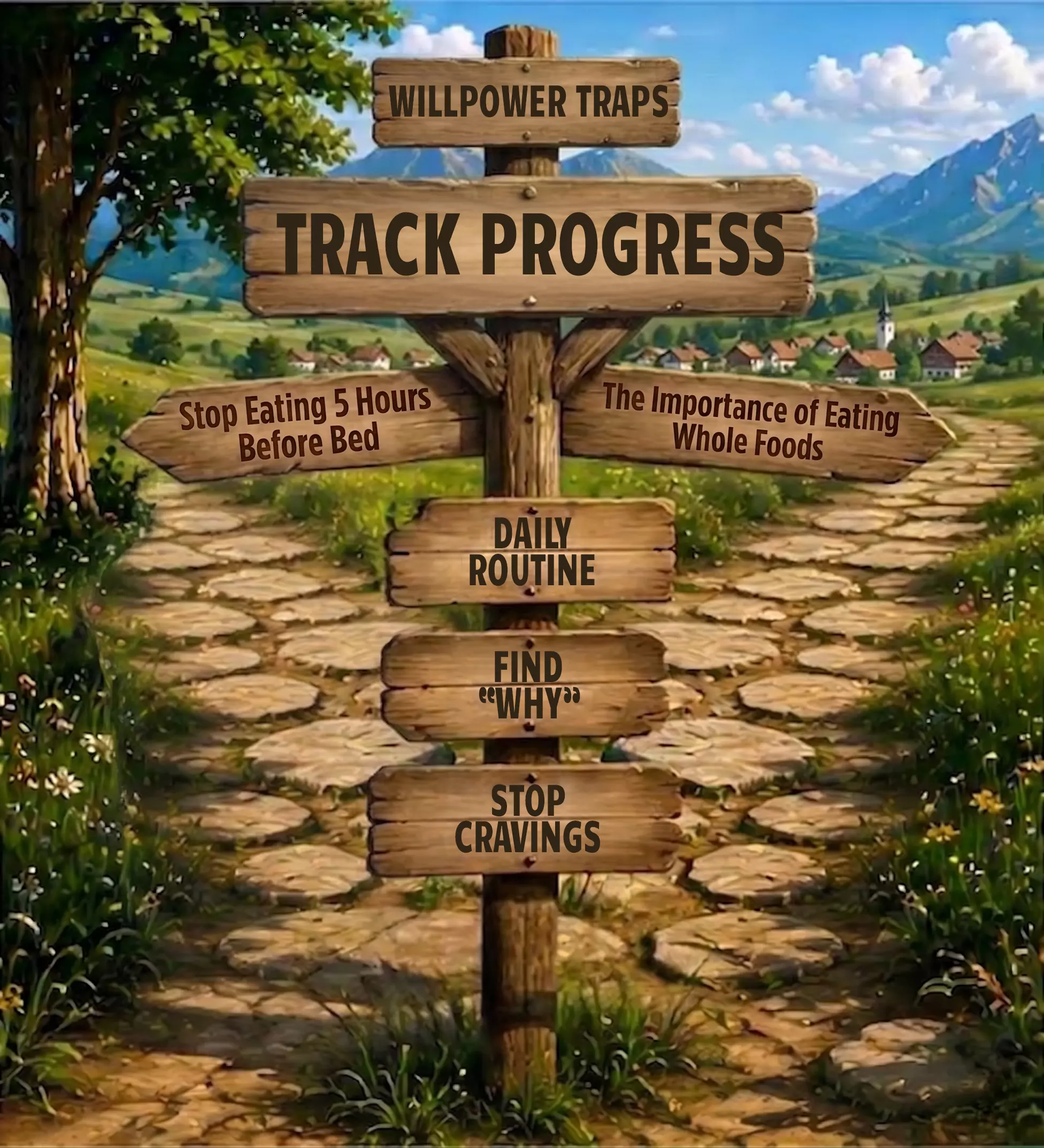
- Willpower Traps
- Track Progress
- Daily Routine
- Find "Why"
- Stop Cravings
Track Your Progress
Daily Tracking With The Right Food And Timing Rewires Your Habits
Most people trying to lose weight focus on one number: calories. But research keeps pointing to a bigger picture. The body responds differently to whole foods and processed foods even when the calorie counts match. It handles the same meal at 6 p.m. very differently than it handles that meal at 10 p.m. And without a visible daily record of healthy choices, the motivation to keep going quietly fades long before real results arrive.
In This Article:
- What the Calendar Method is, why paper beats apps for building lasting habits
- How four simple daily marks create the visible proof your brain needs to stay motivated
- Why a wall calendar outperforms willpower as a long-term weight loss tool.
- Why two people eating the same number of calories can get completely different results.
- How whole, single-ingredient foods burn more calories in ways processed foods never can.
Calories matter. But they are not the whole story, and often they are not even the most important part. What you eat changes how your body handles every calorie you take in. When you stop eating at night changes whether those calories get burned or stored while you sleep. And whether you track your daily habits in a way you can actually see changes how long your motivation holds.
You stare into the mirror and see the same face you saw last month. The belly has not moved. The exhaustion has not lifted. You have tried to diet more times than you can honestly count, and each attempt ended the same way: standing in a kitchen at some late hour, eating something you had promised yourself you would not eat, with the quiet, sinking feeling that you had failed again.
Here is the truth nobody has told you clearly enough: you have not failed. You have been measuring the wrong thing. And that one mistake has been costing you everything.
The Weight You Were Given Before You Knew Any Better
The extra weight most of us carry as adults has roots that go back further than any single bad week. Many people grew up in households where highly processed snacks were always within arm's reach, where comfort and food were intertwined before anyone was old enough to understand nutrition. Chips were beside the television. Candy sat on the counter. Fast food was the solution to a busy night. Nobody explained what was happening inside the body. Nobody needed to, because everyone around you was eating the same way.
Every extra pound you carry now is, in a very literal sense, a physical record of those years. Fat is stored energy. It is your history, written in your body's own language, layered around your midsection and under your chin and across your face. That is not a judgment. It is biology. And it points toward something important: if your body has been silently recording your past choices all this time, then recording your new choices in a way you can actually see might be the most powerful thing you can do going forward.
Why the Bathroom Scale Has Been Working Against You
For most people, the bathroom scale is the only tool they have ever used to judge whether a diet is working. Step on it each morning. Watch the number. Let it decide how the next sixteen hours will feel. And when the number creeps upward after a day when you genuinely tried, feel the familiar collapse of motivation and reach for something to make yourself feel better.
The problem is that the scale is measuring the wrong thing. Research has shown that body weight can shift by as much as one to two kilograms in a single day due to changes in hydration, food still moving through the digestive tract, hormones, and even the time of day you step on the scale (Pacanowski et al., 2015). That morning number is not a reliable indicator of whether you are losing fat. It is reflecting biology, not effort. It cannot see the muscle you are building alongside the fat you are losing. It has no idea that a good workout causes temporary water retention that inflates the reading for a day or two. And it has been robbing you of your wins for years.
Visual progress charts and self monitoring tools for actual behaviors, rather than outcomes alone, consistently outperform scale reliance in long term weight management studies (Neve et al., 2013). A National Institutes of Health clinical study confirmed that frequent self monitoring of behavior, not just outcomes, is among the most effective tools available for sustained weight change. The scale shows you where you ended up. What you need is a tool that shows you what you are actually doing.
Real Progress Shows Up Long Before the Mirror Does
Genuine progress begins in ways most people are trained to ignore. It appears in the Thursday morning when your jeans button without a struggle. It shows up as the walk across the parking lot that does not leave you winded. It lives in the night you slept through without restlessness. It is the afternoon energy that holds up past three o'clock for the first time in months. It is fewer cravings, less bloating, and a subtle improvement in mood that you cannot quite explain but cannot quite deny either.
These are not consolation prizes for people who are not losing weight fast enough. They are biologically meaningful signals that your body is responding to better inputs. Reduced inflammation, improved blood sugar regulation, and better sleep are all occurring in the background before any dramatic change appears in the mirror. The CDC recognizes that even modest weight reduction, roughly five percent of total body weight, produces clinically significant improvements in blood pressure, cholesterol levels, and blood sugar, changes that can extend your life even before anyone around you notices a difference (Centers for Disease Control and Prevention. (2024). Losing weight. U.S. Department of Health and Human Services).
The tragedy is that nobody taught you to count these wins. You were handed a scale on day one and told that was the only score that mattered. So you missed the evidence that you were actually winning.
The Calendar Method: Recording Your New History
The Calendar Method described below captures something that behavioral science has been confirming: your body has been recording your unhealthy choices as stored fat for years. The most powerful countermove is to record your healthy choices somewhere you can see them just as clearly. The calendar becomes a visual diary of your effort, growing one mark at a time, building the kind of evidence your brain needs to stay motivated.
The setup is intentionally simple. Take four monthly paper calendars and tape them to a wall you walk past every single day, somewhere prominent, somewhere you cannot easily ignore. Not hidden in a drawer. Not buried in a phone app. On your wall, at eye level, right where you live your life. Each day you follow your healthy habits, you mark the calendar. Each mark links to the ones before it. Over weeks, the filled squares tell a story about a person who kept showing up, and that story has genuine motivating power.
The calendar makes healthy living constructive rather than purely restrictive. Without a visible record of accomplishment, dieting feels like nothing but deprivation and struggle. There is no evidence of progress, no sense of building toward anything, just effort disappearing into a void. The calendar changes that entirely. You are no longer just suffering through days. You are building something you can point to.
What Your Brain Actually Needs to Keep Going
The reason visible tracking works so well comes down to dopamine, the brain's primary motivation and reward chemical. Dopamine does not wait for you to cross the finish line. It fires when you see evidence that you are moving toward a goal, even in the smallest increments (Volkow et al., 2011). Marking a calendar triggers this response. The mark itself becomes a tiny, immediate reward that your brain can grab onto, and it makes the next day a fraction easier to begin.
This matters in a specific and important way for people who have carried extra weight for a long time. Research has shown that individuals with obesity display reduced dopamine D2 receptor availability in the brain regions that regulate motivation, impulse control, and reward processing (Wang et al., 2001; Volkow et al., 2011). Years of eating highly engineered food can alter the brain's reward circuitry in ways that make ordinary sources of motivation feel flat or insufficient. Studies of ultra processed food consumption suggest that chronic overconsumption disrupts prefrontal control and reinforces compulsive eating patterns through the same neurological mechanisms involved in drug dependence (ScienceDirect, 2026). This is not a character flaw. It is neurobiology.
A visible, physical tracking system helps work around this challenge. When you create your own daily reward by placing a mark on a calendar, you give your brain the dopamine signal it needs without waiting for outcomes that may be weeks away. You are building an external scaffold to support motivation while your internal reward system gradually recalibrates through better eating and regular movement.
There is also a powerful psychological force that makes streaks so hard to break. Behavioral economists Daniel Kahneman and Amos Tversky documented what researchers call loss aversion: the well replicated finding that people feel the pain of losing something roughly twice as intensely as the pleasure of gaining something equivalent. When you have thirty days of marks on your calendar, the prospect of breaking that streak produces a genuine feeling of loss, and that feeling keeps you going on the evenings when nothing else will (Kahneman and Tversky, 1979).
Willpower Was Never the Answer
Stop blaming yourself for a lack of willpower. Willpower is not a personality trait. It is a finite cognitive resource that depletes through the day, just like physical energy, and it depletes faster when you are stressed, sleep deprived, or emotionally overwhelmed (see Willpower Traps). Research in behavioral economics and cognitive psychology consistently shows that people do not abandon healthy habits because they are fundamentally weak. They abandon them because the systems they are using demand continuous willpower with no visible reward, no external reinforcement, and no way to feel like they are making any progress.
If highly palatable, engineered food is within reach and the environment around you is not set up to support your goals, your willpower will eventually give out. This is not a personal failure. It is the predictable result of fighting the wrong battle with the wrong tools. Processed food is specifically designed to override the brain's satiety signals. A controlled NIH study found that participants eating an ultra processed diet consumed approximately 500 more calories per day than those eating minimally processed food, even when the two diets were matched on paper for macronutrients and fiber. The ultra processed group also gained weight over the study period, while the minimally processed group lost it (Hall et al., 2019). The food itself was working against them.
The calendar system is built for a world where willpower is scarce, because it replaces willpower with visible proof. You stop relying entirely on internal resolve and start relying on external evidence. The chain of marks on your wall becomes something worth protecting, and protecting it requires far less energy than manufacturing fresh motivation from nothing every single morning.
The Four Marks You Earn Each Day
The Calendar Method tracks four daily behaviors. Each one earns its own mark. None of them requires athletic ability, expensive equipment, or extraordinary discipline. They require only consistency.
The first mark goes to meal preparation. Before the day gets loud and the hunger becomes urgent, you prepare real, whole, single ingredient foods in advance. Chicken, eggs, sweet potatoes, rice, oatmeal, salad, fruit, soup. The exact foods matter far less than the act of having them ready before the moment of weakness arrives. When whole, single ingredient, non-processed food is already prepared, the decision has already been made. You are not relying on willpower in the middle of a stressful afternoon. You are relying on earlier planning.
The second mark goes to eating mostly whole foods. Each day that you manage to eat primarily minimally processed foods instead of reaching for packaged snacks, fast food, or sweetened drinks, you earn a mark. Over time, these marks become proof that you have been consistently choosing foods that support your body rather than working against it.
The Importance Of Eating Whole, Single Ingredient Foods Over Processed Foods, Even When Calories Stay The Same
A Calorie Is Not Just a Calorie
Most people have heard the rule at least once in their lives: eat fewer calories than you burn, and the weight will come off. That idea is not completely wrong. Calories do matter. But that simple rule leaves out a powerful truth that science has been piecing together for decades, one that can explain why two people eating the exact same number of calories every day can have completely opposite results on the scale.
Imagine Person A eating grilled chicken, roasted sweet potato, broccoli, a handful of almonds, and fresh berries throughout the day. Imagine Person B eating chips, crackers, frozen meals, a protein bar, a sweetened yogurt drink, and a few cookies. Both reach 1,800 calories by dinnertime. Both believe they are doing the same amount of work. But inside their bodies, a completely different story is playing out.
Person A is likely to lose weight. Person B may stay exactly where they are or even gain. The calories on the label match. The results do not. Understanding why is one of the most useful pieces of nutrition science available today.
The third mark goes to movement. Twenty two minutes of physical activity earns it. A brisk walk qualifies. A beginner workout qualifies. A slow jog, a bike ride, or a short session at a gym all qualify. The CDC recommends at least 150 minutes of moderate physical activity per week for overall health maintenance, which averages to roughly twenty two minutes per day (CDC, Physical Activity). Intensity matters far less than regularity. A short session every day builds a stronger habit foundation than an exhausting workout twice a week. See Daily Routine for more information on this step.
The fourth mark may be the most important: do not eat anything five hours before you go to sleep.
Counting Calories Won't Work if You're Eating at the Wrong Time
Why not eating food five hours before bed is the most important weight loss habit most people miss
The house is quiet. The dishes are washed. The day is finally over. And somewhere between the couch and the television, a hand reaches into a bag of chips. Maybe it is a bowl of cereal. Maybe it is leftover pasta heated up at 10 at night, or a few spoonfuls of peanut butter standing in front of the open fridge. The calories get noted in an app. The math still adds up. The diet is technically on track.
But the scale does not move. Or worse, it goes up.
This is not a willpower failure. It is a biology problem. And the solution is not a stricter calorie limit. It is a firm, science-backed deadline: stop eating at least five hours before you go to sleep.